
If you’ve spent any time in the online business world, someone has probably told you: “Just keep building trust, and the money will follow.” In general, it’s solid advice. But there’s a problem. And if you’re retired, or approaching retirement, you already know why “building trust first” doesn’t work for you.
Time.
The Part Nobody Talks About
There’s something quietly fascinating happening in the world of online marketing right now, and it’s called dark social.
In short: your analytics dashboard is probably lying to you.
People share links, recommend articles, and pass along ideas every day — through WhatsApp groups, text messages, email forwards, DMs, and private chats. When someone clicks one of those links, your analytics often can’t track where it came from. It just shows up as “direct traffic,” as if visitors materialised from thin air.
They didn’t appear out of nowhere. They arrived because someone trusted the person who shared the link enough to click it.
That’s the power of trust in action. And in theory, it’s the holy grail of online marketing.
But here’s where it gets complicated — especially for those of us who aren’t in our thirties and can’t afford to spend three to five years quietly building an audience before we see a return.
We’re Living Through a Trust Recession
Trust online has become genuinely hard to earn — particularly from newcomers.
And it’s not hard to understand why. Too many people have been burned. They clicked the exciting promise of fast money, handed over their email address (or worse, their credit card), and got nothing in return but disappointment and a dodgy upsell sequence. Some of them were targeted so aggressively and so cynically that they’ve become almost permanently suspicious of anything that even smells like online marketing.
So when you show up with your honest, realistic message – “this takes real work and real time” – some of them switch off immediately. Why would they stick around for the slow, sensible route when there are apparently exciting shortcuts everywhere they look?
Others may even wonder if you’re the one running a double-bluff.
The cruellest part? By the time a newcomer has been burned enough times to appreciate that your straightforward approach is actually the trustworthy one, they’re often too burned out to try again.
For those of us in our sixties, seventies, or beyond, there’s an added layer of frustration: even when we do successfully build trust with someone new, the timeline from “they trust me” to “they’re earning commissions themselves” can feel impossibly long.
I’ve felt this personally. Watching someone join a business I genuinely recommended, knowing they trusted me enough to take that step, and then seeing them not earn anything, probably because they hadn’t yet built up enough trust with their own audience. It’s disheartening.
But Here’s the Real Question
Trust is all very well — but does it pay the bills?
For most retirees, the honest answer to “Why am I in online business?” is: to make money. To supplement a pension. To have a bit of financial breathing room. To feel productive and useful.
And at a certain point in life, you simply can’t afford to wait three years for a strategy to mature.
I’m in my mid-seventies. I continue to work on building trust: writing emails, publishing blog posts, and showing up consistently. And I believe in that work and enjoy it.
But I’m also a pragmatist. So I’ve started exploring something that changes the equation entirely.
A Smarter Route for Retirees: CPA Marketing
Most people starting out in online business default to standard affiliate marketing — and the model is straightforward enough:
Someone buys something through your link → You earn a commission.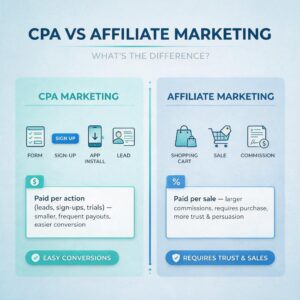
Simple. But it hinges entirely on someone making a financial commitment. And that requires trust. Which takes time to build. Which, as we’ve established, is the one thing retirees are shortest on.
CPA marketing works differently.
CPA stands for Cost Per Action — and the “action” doesn’t have to be a purchase. It might be filling in a form, signing up for a free trial, entering a competition, or downloading a guide. The person you’re referring doesn’t spend a single penny. They simply do something.
And you get paid.
Here’s why this is so interesting for retirees specifically:
- Less trust is required. You’re not asking someone to hand over money based on your recommendation. You’re simply pointing them toward something free or low-commitment. That’s a much easier ask — especially for newcomers who are already wary.
- You can still build your list. Many CPA offers involve email opt-ins, which means you can continue building trust over time. You just don’t have to wait for that trust to develop before you see any return fully.
- The commissions may be smaller — but something is better than nothing. Especially when you’re not waiting months or years for a sale to happen.
The Honest Summary
Here’s what I’ve come to believe after years in this industry and a great deal of trial and error:
The “build trust first” model is real, and it works. Dark social — all those private conversations and quiet recommendations — is proof that genuine trust creates genuine results. When someone passes along your content in a WhatsApp group because they genuinely found it useful, that’s marketing at its most powerful.
But for retirees, or anyone who needs results within a realistic timeframe rather than a theoretical one, trust-building alone isn’t enough. You need a strategy that can work while you build trust, not one that pays out only after years of effort.
CPA marketing isn’t a shortcut or a get-rich-quick scheme. It’s simply a model that lowers the barrier for the people you’re trying to reach — and removes the catch-22 of needing trust before you can earn, and needing earnings to justify the time spent building trust.
It’s practical. It’s realistic. And for those of us who’ve earned our grey hairs, that matters.
If you’d like to learn more about how CPA marketing works — and whether it might be the right fit for where you are right now — you can learn more here.
The course was created by an online marketer who had earned my trust over several years – he first uses the models he teaches, then automates them with shortcuts he learned from his own experience.
Very important – one danger with trying to learn CPA yourself is that you may be tempted to run paid adverts to ‘speed up your results’. This can be a path to ruination, as you will be competing with others far more skilled than you are. So the course instructor focuses first on using free traffic sources.
Got thoughts on this? I’d genuinely love to hear them — especially from fellow retirees navigating the online business world. Drop a comment below or get in touch directly.