You can earn extra income after retirement without taking on a stressful or highly technical job. Social media management is one of the more practical online side hustles because it centers on simple, useful work.
In plain terms, you help a business stay active online. You write posts, schedule them, reply to comments, and keep things organized. For many retirees, that is a realistic fit because success comes from steady service, trust, and patience, not hype or fast money.
Key Takeaways
- Retirees can start social media management with one platform and a few basic skills.
- Small businesses usually need steady posting and clear communication, not fancy marketing jargon.
- Life experience, reliability, and good judgment often matter more than age or advanced tech skills.
- A simple portfolio and a narrow offer make it easier to win first clients.
- Can work well with small local businesses as your target audience.
- This works best as a real service business, built with practice and consistency.
What a social media manager actually does day to day
The core tasks: posting, replying, planning, and tracking results
Most social media managers for small businesses do not spend their day building huge campaigns. They handle repeat tasks that keep a business visible and responsive.
That often means writing short captions, choosing a photo, scheduling posts for the week, and answering simple comments or direct messages. It can also include updating a content calendar and checking which posts got the most reach, comments, or clicks. Many clients care more about consistency than clever ideas.
The skills that matter most for beginners
You do not need to be young, trendy, or glued to your phone. You can do it on your desktop or laptop.
Clients often value dependable help more than flashy talent.
Retirees already bring useful strengths, such as staying organized, writing clearly, and treating people with respect. If you want a quick picture of the basics, this video on social media manager skills gives a helpful overview. The technical part can be learned. The people skills take longer, and many retirees already have them.
Why retirement can be a strong starting point for this kind of work
How life experience helps you understand customers and build trust
A retiree often understands real customers better than a beginner fresh out of school. Years of work, family life, and community involvement build empathy and common sense.
That matters on social media because business owners want posts that sound human. They also want someone who can spot what feels pushy, careless, or off-brand. Mature judgment helps you write with a steady tone, especially for local businesses that rely on trust.

### Flexible work that can fit around retirement life
This kind of work can stay part-time and remote, which is a big plus in retirement. You can take on one client, then add more only if the schedule still feels comfortable.
That flexibility matters if you travel, help with grandkids, or want slower workdays, because boundaries matter. Social media can expand to fill every hour if you let it. A better plan is to offer limited support, set office hours, and keep response times clear from the start.
The simplest way to get started as a retiree social media manager
Pick one platform and learn it well first
Trying to learn every platform at once creates stress fast. Start with one place where small businesses already spend time, such as Facebook, Instagram, or LinkedIn.
Facebook is often a smart first choice for retirees because many local businesses already use it. LinkedIn also works well if you want to help coaches, consultants, or former business contacts. When you focus on one platform, you learn faster and get better results sooner.
Build a small practice portfolio before you pitch clients
You do not need paid clients before you can show your work. You need proof that you can create useful posts and stay consistent.
Your own profile can be the practice ground and showcase for your talents.
Make sample posts for a pretend business, create a one-week content calendar, or volunteer for a church, club, or nonprofit. Even managing a friend’s local business page for a short trial can help. Practice beats waiting.
Learn the basics of content, scheduling, and simple analytics
Your starter skill set can stay small. Learn how to write a short post, add a clear call to action, schedule content, and read basic numbers.
You only need to understand a few simple measures at first, likes, comments, shares, reach, and clicks. Those numbers help you spot what people care about.
How to find your first clients without using complicated tactics
Start with people and businesses you already know
Your first client often comes from your existing circle. Former co-workers, local shop owners, churches, clubs, and nonprofit leaders already know your personality.
That trust matters because hiring help with social media feels personal. Start with a simple message.
Tell them you help small businesses post consistently and stay active online. Keep it clear and low-pressure.
Use a simple offer that solves one clear problem
A narrow offer is easier to explain and easier to deliver well. Instead of selling “full social media management,” offer one small service.
You might create eight posts per month, build a basic content calendar, or reply to comments three days a week. Small business owners often buy relief first. They want one task taken off their plate.
Set fair prices and avoid underselling yourself
Many new freelancers charge too little because they feel unsure. Then they do extra work for free and burn out.
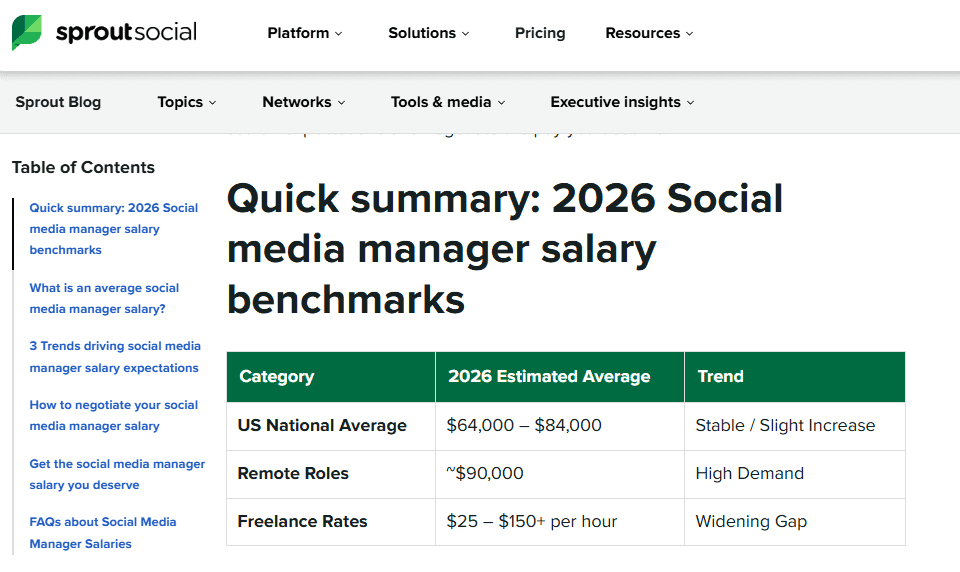
Here are some 2026 prices that are being quoted by Sprout Social. BUT – these are probably for larger businesses and full-time.
It would be a rare small business that was willing to pay such prices. I include them merely so you don’t undersell your services. Base your quote around the hourly freelance rate, rather than the salaries. You probably don’t want a new career, just a side hustle.
Price your work around time, effort, and value. A clear monthly fee for a limited service is often easier than hourly billing at the start. If a client wants more, raise the scope and the price together.
Most first clients are not hiring for genius. They are hiring for reliability and relief.

Tools, habits, and boundaries that make the job easier
Use beginner-friendly tools instead of trying to do everything manually
The tool I recommend is Posting Pilot (affiliate link), it lets you schedule a week’s worth of content in 20minutes (after set-up).
As the ‘brand brain’ learns more about the business, performance improves.
Use the free trial to practice by using it on your own profile to showcase your social media talents. The base level price is very affordable when you consider it can be the start of a whole new retirement business.
Posting Pilot isn’t just a tool for solopreneurs to take control of their own social media profiles – you can then use it to sell your services as a social media manager to small businesses.
Imagine a small, local pizza shop – struggling to compete with the big brand names.
The owner knows he should be posting on social media to attract new customers – but at the end of the day, he’s just too exhausted to be fighting social media.
With Posting Pilot, you have two options:
- Introduce the owner to the software, so he can make his own posts on a Sunday afternoon, then leave them to run over the weekend.
- Sell your own services as a social media manager, and use Posting Pilot to run the business for them
Create a routine that keeps work manageable
Posting Pilot’s batching helps a lot as you write several posts in one sitting, schedule them together, and set one block of time for replies and reports.
Short, focused work sessions often fit retirement life better than long days. A checklist also helps because you do not have to keep every detail in your head.
Protect your time, energy, and privacy
Use a basic agreement, even with friendly clients. It should list what you do, when you work, how quickly you respond, and how payment works.
Also, be careful with account access. Use proper admin access instead of sharing personal passwords when possible.
Most of all, do not take on more clients than you can handle comfortably.
Common mistakes new retirees should avoid when entering social media management
Trying to be active on every platform at once
Spreading yourself thin hurts quality. One well-run platform is better than three neglected ones.
A focused plan also makes it easier to learn what works. Once you feel steady, you can add another platform if the client needs it.
Believing income will come fast without practice or patience
Many retirees come to online work after seeing big promises in affiliate marketing.
The hard truth is that a steady income usually comes faster when you offer a real service that solves a real problem.
That lesson saves time and frustration. Social media management is honest work, not easy money. You learn, improve, and build trust one client at a time.
Ignoring client needs and measuring the wrong things
A post with lots of likes may do nothing for the business. A pragmatic client cares more about phone calls, website visits, booked appointments, or comments from real local customers.
So pay attention to their goal first.
When you track the right result, your work becomes more useful and easier to keep selling.
A steady side hustle you can build
Retirement can be a strong time to start this work because you already have traits many clients want: good communication, experienced judgment, and follow-through. Those strengths are harder to teach than posting tools.
Start small, learn one platform, and build proof before chasing more clients. With consistency and clear boundaries, social media management can become a low-stress way to earn extra income and stay useful on your own terms.
FAQs about becoming a social media manager after retirement
Do I need experience to start?
No, but you do need practice. A small portfolio with sample posts or volunteer work is enough to begin.
Do I need certifications?
Usually not. Clients care more about clear communication, steady work, and visible proof that you can handle their page.
How much time does it take each week?
That depends on your offer. One small client might take three to five hours a week once you have a routine.
What type of clients are easiest to start with?
Local businesses, nonprofits, churches, clubs, and former work contacts are often the easiest first clients. They already understand who you are and may need simple help, not a big agency package.
Your Next Step to Start as a Social Media Manager
Take a free trial of Posting Pilot (affiliate link) here.
Inside, you will see how you can show demonstrations to small businesses that may become your clients.